
Mastering Answer Engine Optimization
Let me tell you, Answer Engine Optimization (AEO) isn’t just a buzzword; it’s the practice of shaping content, metadata, and structured signals so that AI-powered systems return a precise, citable answer or summary rather than just a link. Here at SpeedScaling, we’ve been on the front lines of this since late 2023, when AEO was just emerging. We immediately saw the writing on the wall and started integrating it into our strategies, bringing clients onto AEO funnels with our AI technology on ClearPath Media. The approach works by aligning content to entities, machine-readable schema, and concise answer formats so Large Language Models and retrieval systems can extract and attribute facts reliably. Readers will learn what AEO means, how it differs from traditional SEO, practical tactics to create entity-rich answers, measurement methods, and structured-data recipes that increase the chances of AI overviews and chatbots citing your content. Many organizations face the problem of losing visibility as users shift from clicking search results to accepting direct AI answers; this guide shows steps to convert authoritative content into extractable knowledge that answer engines use. The article maps core definitions and components, contrasts AEO with SEO, lays out tactical playbooks for content and schema implementation, explains KPI frameworks and tables for tracking, and closes with future trends and ethical considerations relevant to AEO and semantic search.
What is Answer Engine Optimization and Why Does It Matter?
Answer Engine Optimization is the intentional practice of creating content and structured signals so AI answer systems return concise, accurate responses that cite your content. From our experience at SpeedScaling, working with clients on ClearPath Media, this isn’t just theoretical; it’s about tangible results. It works by declaring entities, relationships, and provenance explicitly so retrieval systems and LLMs can surface and attribute information, improving visibility in AI overviews and chatbots. The direct benefit is increased brand mentions, authoritative citations, and new referral paths that bypass traditional click-based traffic, which in turn expands discoverability across conversational interfaces. Understanding this definition clarifies why content teams must shift from purely keyword-focused pages to entity-first, sourceable answer fragments that machines can use.
How is AEO Defined in Digital Marketing?
AEO in digital marketing is defined as a set of practices that optimize content for answer retrieval by AI systems, prioritizing entity clarity, provenance, and concise responses over ranking signals alone. It maps to semantic SEO and knowledge-graph thinking: entity → relationship → attribute triples are declared in content and structured data so machines can link facts. For example, an entity-first FAQ that includes explicit about/mentions properties allows an AI overview to extract a one-paragraph answer and attach a citation. This entity-centric definition positions AEO as a complementary discipline to existing marketing goals oriented toward visibility and trust.
Structured Data Markup and Schema.org for SEO
Structured Data Markup allows Web developers to embed semantics in pages, thus enabling clients (search engines, client apps etc.) to distil machine-readable resource descriptions from code. This approach emerged from the Semantic Web paradigm as a powerful alternative to traditional Web scraping. Its enablers are dedicated extensions (e.g., RDFa) and controlled vocabularies (e.g., Schema.org). Originating in a different context, Enterprise Modelling methods rely on diagrammatic means for describing and analysing an enterprise system in terms of key properties and conceptual abstractions. Hence, both the Semantic Web and Enterprise Modelling paradigms share a common interest in machine-processable semantics towards the goal of elevating semantics-awareness in information systems and decision support. Inspired by this overlapping, the paper proposes a mechanism for streamlining semantics between Structured Data Markup and enterprise modelling methods. Towards this goal, it employs the Resource Description Framework and the Agile Modelling Method Engineering Framework.
2. Structured Data Markup is being advocated as a search engine optimisation (SEO) technique enabled by semantic technology grafted on traditional Web development practices [1]. The origins of this approach may be traced back to data gleaning from XML documents [2] and to microformat profiles [3]. More recently, the lessons learned from microformats have led to the centralisation of prominent description vocabularies under the Schema.org “umbrella terminology” [4] founded and maintained by the big search engine providers (e.g., Google, Yahoo, Microsoft). From a conceptual perspective, Schema.org can be considered an ontology – i.e., it provides a consensus on terms (categories and properties) that should be used to describe often searched types of resources: organisations, persons, events, actions etc. The Schema.org terminology is complemented by syntaxes that can extend content
Streamlining structured data markup and agile modelling methods, AM Ghiran, 2017
What Are the Key Components of AEO?
Key components of AEO are entity-rich content, structured data, explicit citations, and intent-aligned answer fragments that machines can extract. Entity-rich content uses clear names, aliases, and attributes so that retrieval systems match queries to canonical entities; structured data declares those entities in machine-readable form; citations supply provenance; and concise answer blocks provide extractable responses. Together these components reduce ambiguity and enable LLMs to surface accurate, citable answers. Recognizing these building blocks makes it easier to design content that serves both human readers and AI-driven answer engines.
Why is AEO Important for AI-Powered Answer Engines?
AEO matters because AI-powered answer engines increasingly favor concise, verifiable content over long-form link lists; they rely on well-structured signals to decide which sources to cite. When content explicitly defines entities and supplies structured metadata, LLM-based systems can reduce hallucinations by referencing authoritative material, which raises the chance of being chosen as the direct answer. The practical impact includes new visibility channels, shifts in referral patterns, and a higher premium on factual accuracy. Given this functional role, content producers must optimize for machine readability while preserving human clarity to earn AI citations.
Autonomous Entity Identification for AI Search
With advances in artificial intelligence and semantic technology, search engines are integrating semantics to address complex search queries to improve the results. This requires identification of well-known concepts or entities and their relationship from web page contents. But the increase in complex unstructured data on web pages has made the task of concept identification overly complex. Existing research focuses on entity recognition from the perspective of linguistic structures such as complete sentences and paragraphs, whereas a huge part of the data on web pages exists as unstructured text fragments enclosed in tags. Ontologies provide schemas to structure the data on the web. However, including them in the web pages requires additional resources and expertise from organizations or webmasters and thus becoming a major hindrance in their large-scale adoption. We propose an approach for autonomous identification of entities from short text present in web pages
Autonomous schema markups based on intelligent computing for search engine optimization, BUD Abbasi, 2022
How Does Answer Engine Optimization Differ from Traditional SEO?
AEO differs from traditional SEO in its objective, format, and success signals: AEO targets direct answers and citations while SEO focuses on ranked listings and click-through traffic. Mechanically, AEO emphasizes entity disambiguation, explicit schema, and concise answer-first content; SEO emphasizes keyword targeting, backlinks, and organic rank. The result is different tactical priorities and complementary outcomes—AEO expands presence inside AI responses while SEO maintains search-engine visibility and site traffic.
What Are the Main Differences Between AEO and SEO?
AEO measures success by mentions, AI-overview citations, and direct-answer presence; SEO measures rankings, impressions, and organic sessions. Formats differ: AEO favors short, authoritative answer blocks and entity statements; SEO often favors comprehensive, long-form pages optimized around keywords and internal linking. Indexing differs too—AEO depends on retrievers and knowledge graphs that match entities and facts, whereas SEO depends on crawler/indexer cycles and ranking algorithms. These distinctions require content teams to adapt workflows for structured metadata and extractable answers.
How Do AEO and SEO Complement Each Other?
AEO and SEO complement each other by sharing authority-building tactics while serving different stages of the user journey: SEO builds topical authority and crawlable depth, and AEO converts that authority into direct citations within AI responses. Practical cross-over tactics include adding schema to high-value SEO pages, creating concise FAQ snippets derived from long-form articles, and using internal linking to surface canonical entity pages. Integrating both approaches increases the likelihood that AI systems will attribute answers to authoritative sources while preserving organic traffic.
How Has Search Evolved from SEO to AEO?
Search evolved from link- and keyword-driven ranking to a mixed model where featured snippets, voice assistants, and LLM overviews favor concise, factual extractions. Milestones include featured snippets and PAA boxes, which introduced extractable answers, followed by voice assistants prioritizing spoken answers, and now LLM retrieval and answer-overview systems that synthesize sources. Drivers include user preference for instant answers and improvements in retrieval-augmented generation. This evolution compels content teams to restructure information into machine-friendly, verifiable fragments.
What Are the Best Strategies to Optimize Content for Answer Engines?
Creating content for answer engines requires entity-first composition, structured-data implementation, concise Q&A blocks, and platform-specific tailoring to be extractable and citable by AI systems. These strategies focus on making relationships explicit so retrieval systems can match user intents to verified facts.
This disciplined approach to content optimization isn’t just theory; it’s what we’ve been executing for clients since late 2023, when AEO was just emerging. At SpeedScaling, we quickly recognized the shift and developed our AI technology on ClearPath Media to build out AEO funnels that deliver verifiable outcomes. We’ve seen firsthand how meticulous planning and execution are critical for achieving direct AI citations and driving new traffic. Below are tactical steps and a comparative table that aligns strategy, entity focus, and expected outcomes to guide implementation.
How to Create Entity-Rich Content for Direct Answers?
Entity-rich content begins by identifying canonical entities, alternative labels, and key attributes that answer likely user questions. With our ClearPath Media AI technology, we streamline this process, ensuring content is not just readable but machine-declarative. Write short, answer-first paragraphs that state an entity, describe its attribute, and cite a source—forming subject → predicate → object triples such as “Product X [entity] provides [relationship] 12-month warranty [attribute]”. Use in-text anchors and visible citations that mirror structured-data about/mentions properties so retrievers can validate provenance. Link concise answers back to fuller resources to preserve SEO depth while enabling AI extraction.
How to Implement Structured Data and Schema Markup for AEO?
Implement JSON-LD using schema types aligned to the content intent: Article or BlogPosting for in-depth pieces, FAQPage for Q&A, HowTo for processes, and Organization or Dataset where entity context matters. Our ClearPath Media platform helps clients automate and validate this, ensuring robust schema implementation. Include about and mentions properties to point at canonical entities and provide sameAs identifiers when possible. Validate with testing tools and ensure visible content corresponds to schema claims to avoid mismatch. Use the checklist below to guide practical implementation.
- Use JSON-LD as the preferred format for AEO.
- Include about/mentions attributes that reference canonical entities.
- Keep schema synchronized with visible page content and update when facts change.
This checklist reduces misalignment between human-readable content and machine-readable declarations and prepares content for extraction by answer engines.
Intro to strategies comparison table: The following table compares practical AEO strategies, the entity each targets, and the expected direct-answer outcomes.
| Strategy | Key Entity Focus | Expected Outcome |
|---|---|---|
| Entity-first content | Core topic entity (person, product, concept) | Extractable one-paragraph answers |
| Schema-first markup | About/mentions, sameAs links | Improved entity recognition |
| Concise Q&A blocks | Question → brief answer pairs | Higher snippet and PAA capture |
| Platform tailoring | Chatbot citation patterns | Increased AI citations on specific engines |
This table clarifies which strategy most directly impacts answer-engine visibility and the nature of the output to expect. The next section explains voice and platform-specific tactics that extend these strategies.
How to Optimize for Voice Search and Featured Snippets?
To capture voice and snippet results, format answers as direct responses to natural-language questions and place a succinct answer (one to three sentences) immediately after each question. Use conversational phrasing and include common long-tail question variants that mirror spoken queries. Mark those Q&A pairs with FAQPage schema and ensure readability for screen readers and voice agents. These tactics increase the probability that an LLM or voice assistant will select your content as the canonical, spoken answer.
How to Tailor Content for Specific AI Platforms Like ChatGPT and Google AI Overviews?
Different platforms prefer different signals: some retrieval systems prioritize structured snippets and visible citations, while chat-focused models value clear provenance and short, citable passages. For chat interfaces, provide explicit citation sentences and short summaries; for AI overviews, ensure comprehensive pages include extractable lead paragraphs and schema declarations. Format sample extractable snippets inside articles and include citation-ready lines to maximize the chance of being referenced. Adapting content to platform behavior increases the likelihood of appearing in platform-specific answer contexts.
How Can You Measure the Success of Answer Engine Optimization?
Measuring AEO ties entity-level outcomes to monitoring processes and tools that detect citations, direct-answer presence, and shifts in referral patterns. For our SpeedScaling clients, this isn’t just about vanity metrics; it’s about proving ROI. Key performance indicators include direct-answer appearances (featured snippets and AI overview citations), chatbot mentions/citations, and semantic ranking for conversational queries. Measurement combines search-console signals, snippet tracking, brand-monitoring, and emerging chatbot-listening tools to triangulate whether AI systems cite your content.
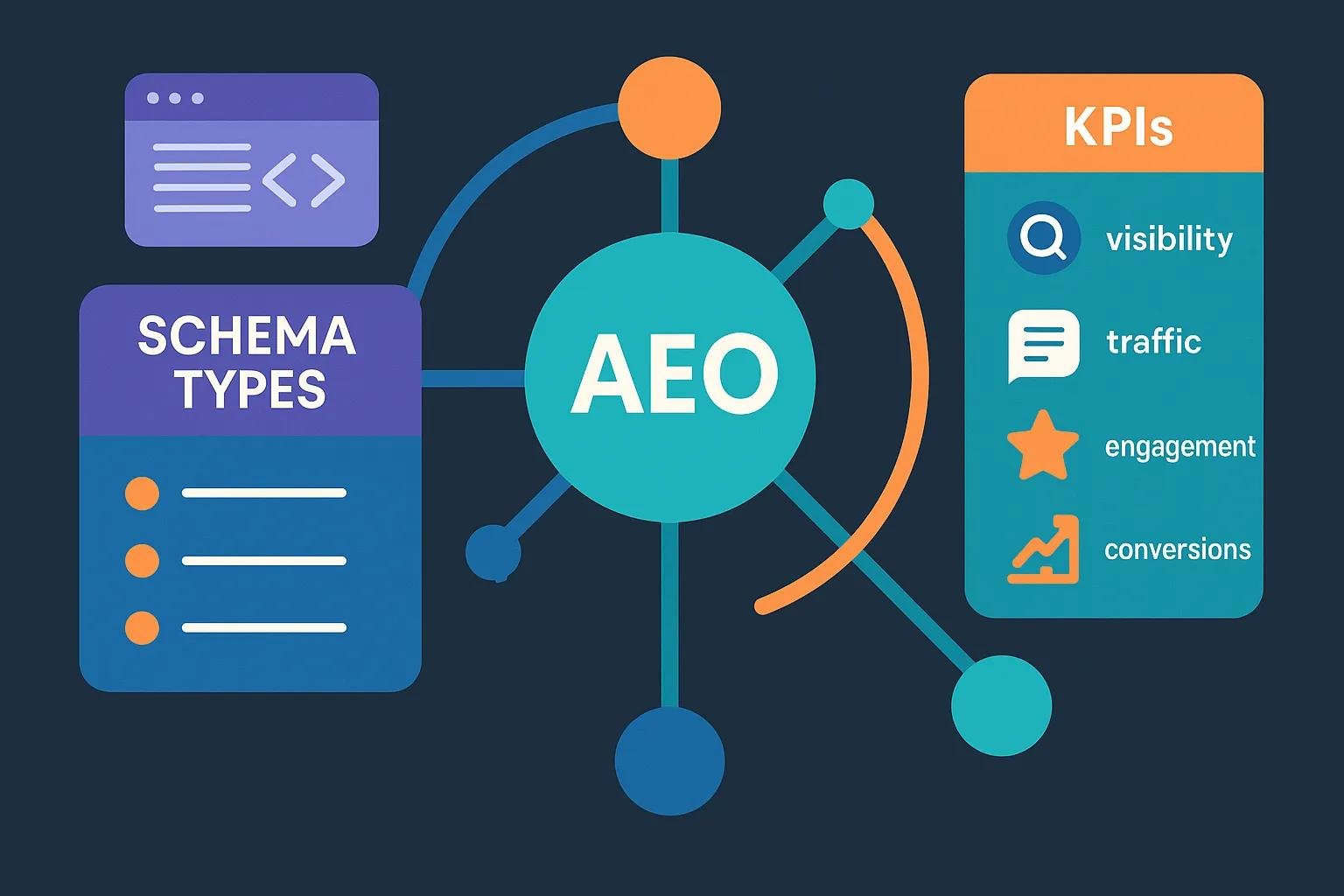
What Are the Key Performance Indicators for AEO?
Key KPIs include direct-answer appearances (featured snippets and AI overview citations), chatbot mentions/citations, and changes in branded/unbranded mention volume. Each KPI matters because it directly signals whether AI systems surface or attribute content. For example, an increase in AI-overview citations indicates improved entity recognition, while stable organic traffic alongside rising mentions suggests new referral channels. Tracking these KPIs informs iterative content and schema adjustments.
Which Tools Help Track AEO Performance?
Use a combination of mainstream SEO tools and specialized monitoring: Google Search Console for query impressions and snippets, enterprise SEO platforms for PAA and featured snippet tracking, and brand-monitoring or custom scrapers to detect AI-overview citations and chatbot mentions. Emerging tools are starting to index AI-overview outputs and conversational answers; combine automated alerts with periodic manual audits for high-value queries. A hybrid toolstack offers broader visibility into AI-driven visibility shifts.
Intro to KPI table: The following table links KPIs to measurement methods and example tools, helping teams choose practical monitoring strategies.
| Entity / KPI | Measurement Method | Tool / Metric Example |
|---|---|---|
| Direct-answer visibility | SERP feature tracking and logs | Search Console impressions; snippet tracking tools |
| Chatbot mentions | Brand-monitoring and custom crawl | Alerts for branded phrases in AI outputs |
| Entity recognition | Semantic rank tracking | Topic clusters and entity-rank reports |
This table maps which metric to watch and how to collect it, enabling regular AEO reporting. The next paragraph explains detection of chatbot mentions and workflows for attribution.
How to Monitor AI Chatbot Mentions and Entity Recognition?
Monitoring chatbot mentions requires alerting on source text and periodic sampling of top queries to inspect AI responses manually. Set up keyword and brand alerts across monitored AI output feeds and maintain a sample dashboard that logs instances of direct attribution, paraphrased answers, and missing citations. Combine automated detection with human review to confirm provenance and to identify hallucinations. Regular audits feed back into content and schema improvements.
What Does the Future of Answer Engine Optimization Look Like?
The future of AEO will be shaped by more advanced retrieval models, better knowledge-graph integration, and stricter expectations for provenance and accuracy. From what we’re seeing with our ClearPath Media clients, as LLMs improve their context windows and retrieval techniques, answer engines will increasingly prefer structured, verifiable facts and explicit citations. Content teams must anticipate these shifts by investing in structured-data hygiene, entity modeling, and processes that ensure factual integrity. This isn’t a ‘wait and see’ game; it’s about getting ahead now.
How Will AI and Large Language Models Impact AEO?
Improvements in LLMs and retrieval will prioritize sources that provide clear entity links and verified facts; models will increasingly rely on knowledge graphs and retrievers that match entity triples. This technical change means content must be precise and machine-declarative to be selected as a source. Content teams should adopt entity registries and canonicalization processes to ensure consistent identification, which in turn supports better AI citations.
What Are Emerging Trends in Conversational Search and Voice Optimization?
Emerging trends include multimodal answers that combine text, images, and data snippets, default conversational interfaces for more query types, and growing importance of short, authoritative answer fragments. Practically, this means integrating structured captions, concise data tables, and audio-friendly phrasing into content design. Preparing content for multimodal retrieval ensures broader coverage across future answer formats.
What Ethical Considerations Should Marketers Know About AEO?
Ethical considerations center on accuracy, transparent sourcing, and minimizing bias; marketers must avoid incentivizing manipulative phrasing that misleads AI systems or users. Implement verification workflows, clearly label opinion versus fact, and include provenance metadata to reduce hallucinations. Responsible citation practices and regular fact audits protect brand trust and reduce regulatory and reputational risk as AI systems become primary answer sources.
How Does Structured Data Enhance Answer Engine Optimization?
Structured data enhances AEO by making entities, relationships, and provenance explicit in machine-readable form so retrieval systems and LLMs can disambiguate and attribute facts. Proper schema selection and use of about/mentions properties create reliable semantic triples that increase the probability of AI-overview inclusion. The following sections explain effective schema types, machine interpretation mechanics, and practical JSON-LD best practices.
What Types of Schema Markup Are Most Effective for AEO?
Effective schema types for AEO include Article/BlogPosting for source context, FAQPage for Q&A extraction, HowTo for procedural answers, Organization for entity context, and Dataset for structured facts. Each schema maps to different AEO needs: FAQPage improves PAA and snippet capture, HowTo surfaces procedural steps, and Dataset can feed precise numeric facts that LLMs cite. Use the schema type that best matches the page’s primary intent to increase extraction likelihood.
Intro to schema table: The table below shows schema types, primary use cases, and recommended implementation tips for AEO.
| Schema Type | Primary Use Case | Example Properties / Implementation Tip |
|---|---|---|
| Article / BlogPosting | Provide source and summary context | include headline, author, datePublished, about |
| FAQPage | Q&A extraction for snippets | structure each Q/A pair and mirror visible answers |
| HowTo | Step-by-step procedural answers | list steps, totalTime, supply about links to entities |
| Organization | Entity context and authority | use sameAs and contactPoint when applicable |
| Dataset | Precise facts and figures | include variableMeasured and measurementTechnique |
This mapping helps choose the right schema for the desired AEO outcome and highlights the properties that matter most for entity recognition. Next we explain how schema aids machine understanding.
How Does Structured Data Help AI Systems Understand Content?
Structured data provides explicit subject → predicate → object triples that reduce ambiguity and improve retrieval precision; for example, “Product A [subject] hasFeature [predicate] 12-hour battery life [object]”. These machine-readable triples assist retrievers in matching user queries to exact facts and support LLMs in assembling accurate summaries with provenance. By disambiguating entities and clarifying relationships, schema accelerates trustworthy citation and lowers hallucination risk.
What Are Best Practices for Implementing JSON-LD and Other Formats?
Prefer JSON-LD for ease of implementation and compatibility with major search ecosystems; include about and mentions properties and reference canonical entity identifiers where available. Validate schema with official testing tools and ensure structured data reflects visible page content to avoid misalignment. Maintain a governance process to update schema when facts change and log schema changes to support audits. These practices ensure structured data remains a reliable signal for answer engines.
What Are Real-World Examples and Case Studies of Successful AEO?
Real-world success in AEO typically involves converting high-authority content into extractable answer blocks, adding structured data, and tracking changes in AI citations and referral behavior. At SpeedScaling, we’ve been driving these results for our clients since late 2023, leveraging our AI technology on ClearPath Media to build out effective AEO funnels. Brands that structured key pages into FAQ and entity pages observed increased mentions in AI overviews and new traffic paths from conversational interfaces. The key is aligning content format and metadata with retrieval patterns used by answer engines, and we’ve got the track record to prove it.
How Have Brands Gained Visibility in AI Overviews and Chatbots?
Brands have gained visibility by publishing concise, authoritative summaries with explicit citations and adding FAQPage or Article schema that mirrors the visible answer. Tactical elements that help include consistent entity naming, visible attribution lines, and short answer-first paragraphs suitable for extraction. Observed outcomes include direct-answer citations in AI overviews, increased branded mentions, and discovery through assistant-driven referrals. These examples demonstrate the payoff when content and metadata are aligned.
What Metrics Demonstrate AEO Success?
Useful metrics include counts of AI-overview citations, growth in branded mention volume, changes in PAA and featured snippet ownership, and shifts in referral attribution from organic clicks to conversational referrals. Reporting should connect these indicators to business outcomes such as increases in assisted conversions or brand queries. Demonstrating improvement across these metrics validates AEO investments and informs ongoing optimization.
How Does AEO Apply Across Different Industries?
Industry application varies: e-commerce benefits from product Q&As and structured specs; healthcare requires strict sourcing, factual verification, and regulatory caution; finance needs transparent sourcing and clear numeric facts. Each sector adapts AEO tactics to compliance and trust requirements—e-commerce emphasizes structured product data and FAQs, healthcare prioritizes authoritative citations and disclaimers, and finance focuses on precise datasets and transparent provenance. Tailoring AEO to industry constraints preserves trust while enabling AI visibility.