
Unlock Business Growth with AEO & SEO
Search behavior is moving from link-based discovery toward synthesized answers, making both search engine optimization (SEO) and answer engine optimization (AEO) essential for business visibility and trust. This article explains what SEO and AEO are, how AI and large language models (LLMs) have changed search mechanics, and why blending both approaches yields better outcomes for brand authority, discoverability, and conversions. Readers will learn clear definitions, side-by-side comparisons, actionable best practices for AEO, unified implementation steps that preserve traditional SEO gains, and forward-looking governance considerations for 2025 and beyond. Pain points such as zero-click results, fragmented measurement, and brand misrepresentation in AI answers are addressed with practical tactics, measurement proposals, and ethical guidelines. The article maps core H2 sections—definitions and evolution, differences and overlaps, benefits of integration, AEO best practices, unified implementation, future trends, and concise FAQs—while weaving in platform-specific advice for Google AI Overviews, ChatGPT, Perplexity, and voice assistants. Throughout, target keywords like seo and aeo optimization, aeo vs seo, and structured data for ai citation are integrated to support semantic discovery and practical application.
What Are AEO and SEO? Defining Key Concepts for Business Growth
AEO (Answer Engine Optimization) and SEO (Search Engine Optimization) are complementary approaches to search visibility: SEO optimizes for ranking signals that drive organic traffic, while AEO optimizes for direct answers and AI citations that deliver immediate information to users. This dual focus matters because LLM-driven responses often select concise, authoritative snippets rather than full pages, and businesses that align content to both models preserve traffic while earning AI-sourced exposure. The immediate benefit is dual-channel presence—ranked listings plus answer citations—which increases brand authority and hedges against zero-click displacement. Understanding AEO and SEO together sets the stage for tactical decisions about content structure, schema, and measurement, which are covered in the following sections and the practical templates that follow.
What is Search Engine Optimization?
Search Engine Optimization (SEO) is the practice of improving a site’s visibility in traditional search engine results through technical, on-page, and off-page tactics that influence ranking algorithms. SEO works by signaling relevance and authority via keywords, backlinks, structured site architecture, and performance metrics such as page speed and mobile responsiveness. Typical metrics include organic traffic, keyword rankings, click-through rate (CTR), and conversion rates, which together measure discovery and commercial outcomes. Because SEO emphasizes both relevance and trust, it remains foundational even as AI answers evolve, and strong SEO signals often improve the likelihood that AI systems will cite or summarize your content.

What is Answer Engine Optimization?
Answer Engine Optimization (AEO) aims to make content directly discoverable and citable by AI-driven answer systems by providing concise, semantically clear, and well-structured answers that LLMs can extract. AEO focuses on entity clarity, succinct Q&A blocks, TL;DR summaries, and schema types (FAQPage, HowTo, Article) that reveal relationships and provenance. The mechanism is simple: AI models prefer content that clearly maps entities and attributes, so content that states facts in entity → relationship → entity patterns is more likely to be used in synthesized answers. The value for businesses is increased visibility inside AI responses and opportunities for brand mention without relying solely on clicks.
The emergence of AI-powered search engines has led to a significant shift in how users interact with search results, underscoring the importance of optimizing content for AI answer engines.
AI-Powered Search and the Rise of Answer Engine Optimization (AEO)
The emergence of AI-powered search engines like Google SGE has led to a significant shift in how users interact with search results. Instead of traditional blue links, users are increasingly presented with direct answers, featured snippets, and AI-generated summaries at the top of the search results page. This paradigm shift underscores the importance of optimizing content for AI answer engines rather than solely focusing on traditional SEO techniques.
How Has SEO Evolved into AEO in the AI Era?
SEO has shifted from ranking-centric optimization toward hybrid strategies because LLMs synthesize information across sources and present direct answers rather than only linking to pages. Historically, featured snippets and People Also Ask boxes were precursors; today, Google AI Overviews and chat-based engines like ChatGPT and Copilot synthesize multiple documents into a single response. This mechanistic transition changes content design requirements: pieces must be both discoverable in the index and excerpt-friendly for AI synthesis. As a result, content creators must think in semantic triples and structured fragments that both humans and machines can interpret quickly.
How Do AEO and SEO Differ? Core Differences and Similarities Explained
AEO and SEO differ in primary goals, content formats, and measurement but share technical foundations like structured data and semantic clarity. SEO optimizes for organic ranking, clicks, and downstream conversions; AEO optimizes for answerability, citation rate, and immediate visibility inside AI responses. Both approaches benefit from the same meronyms—structured data (FAQPage, HowTo, Article), internal links, and clear entity signals—but prioritization and content shape differ. Recognizing these differences allows businesses to design content that satisfies both ranking algorithms and answer engines, ensuring broad visibility.
Introductory comparison table explaining core distinctions:
| Approach | Primary Objective | Typical Content Format | Key Metric |
|---|---|---|---|
| SEO | Drive organic traffic and conversions | Long-form guides, pillar pages, blogs | Rankings, organic sessions, conversions |
| AEO | Earn direct answers and AI citations | Q&A blocks, concise summaries, FAQs | AI citation rate, answer impressions, zero-click visibility |
| Unified | Maximize multi-channel presence | Hybrid content with summaries + depth | Combined metrics across SERP and AI answers |
What Are the Primary Goals of AEO vs. SEO?
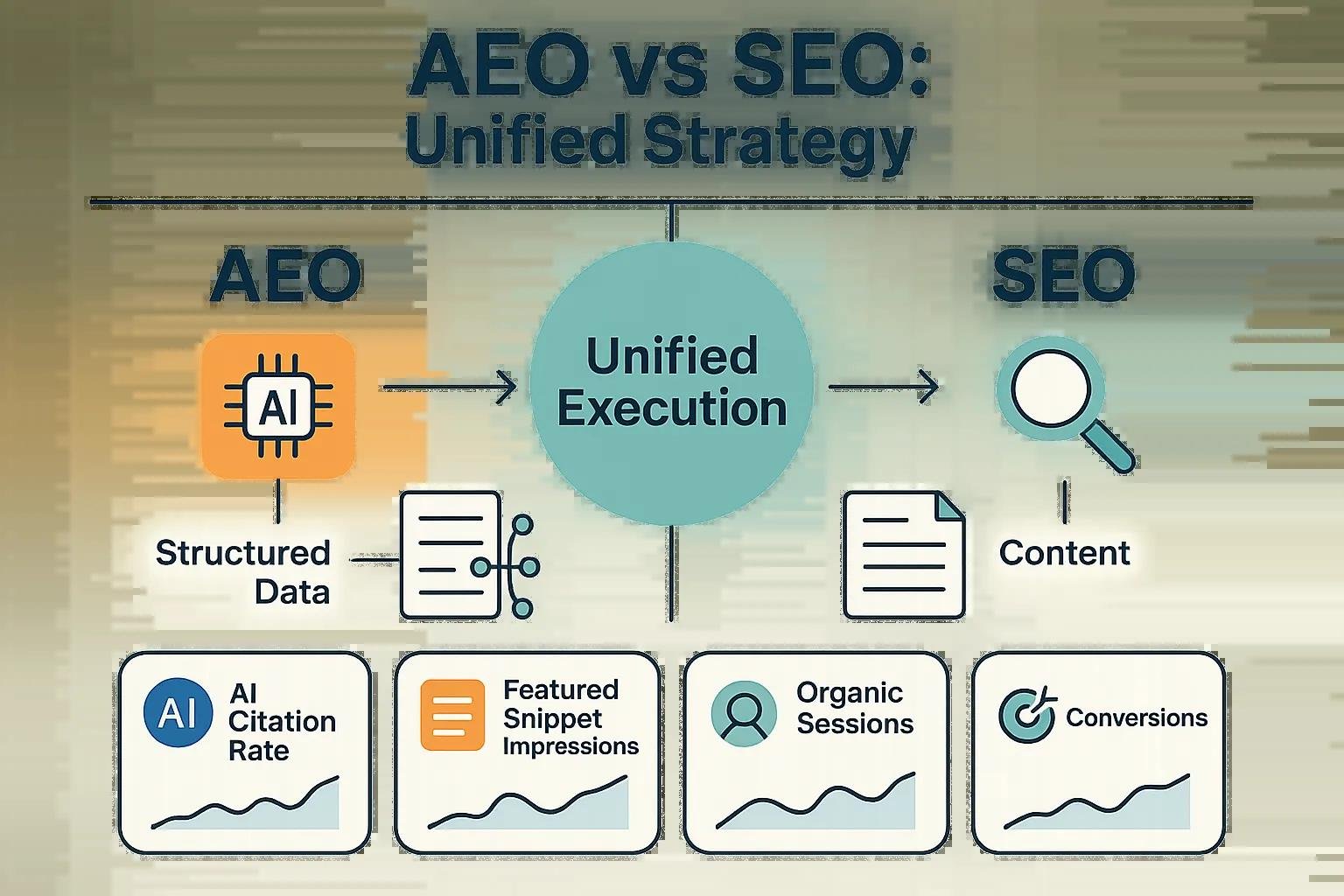
AEO aims to be selected as the source for direct answers that LLMs cite; SEO aims to rank highly in traditional search results to earn organic clicks and conversions. The mechanisms differ: AEO emphasizes concise, authoritative answer nodes; SEO emphasizes topical depth, backlinks, and technical performance. Each goal yields distinct KPIs—AI citation rate and featured-snippet impressions for AEO, keyword positions and organic conversions for SEO. Yet both benefit from semantic clarity and consistent source attribution, which together increase trust and downstream engagement.
How Do Content Formats and User Behavior Vary Between AEO and SEO?
AEO favors succinct, direct-response formats—bulleted lists, punchy TL;DR, and clear Q&A—because voice and chat interfaces need extractable snippets. SEO often uses long-form, comprehensive content to satisfy broad informational intent and to capture long-tail queries. User behavior reflects this: AEO interactions tend toward zero-click satisfaction and immediate answers, while SEO interactions generate exploration, site sessions, and transactional flows. Adapting to both behaviors requires content that supports excerpting while offering fuller context when users choose to click.
Which Metrics Best Measure AEO and SEO Success?
Measure AEO with AI citation rate, answer impressions in platforms, and PAA/featured snippet appearances; measure SEO with ranking positions, organic sessions, and conversion rates. Tools like Google Search Console, GA4, and specialized AI visibility trackers can capture featured snippet impressions and zero-click trends, while manual SERP reviews by platform (ChatGPT search, Google AI Overviews, Perplexity) reveal citation behavior. A regular reporting cadence—weekly for trending AI citations, monthly for SEO traffic—helps teams act on early signals and align content updates with observed platform behaviors.
What Overlapping Tactics Can Businesses Use for Both AEO and SEO?
Several tactics deliver shared benefits across both disciplines by improving machine readability and user experience. Structured data, clear semantic headings, concise lead summaries, fast mobile-first pages, and robust internal linking are foundational. Implementing these tactics increases the likelihood of both high rankings and AI citations, which together create resilient search presence. Prioritizing these shared optimizations yields compounded gains in visibility and trust across channels.
Why Should Your Business Combine AEO and SEO Strategies? Benefits of Integration
Combining AEO and SEO creates a multi-layered visibility strategy that captures both conventional organic traffic and AI-driven answer placements, increasing total exposure and reducing dependence on any single discovery channel. Integrated strategies strengthen brand authority because consistent, well-attributed content surfaces across search types and platforms, reinforcing credibility. For businesses, this means diversified lead flows: some users click to transact, others convert after being informed by an AI-sourced answer. Integration also future-proofs content investments by ensuring adaptability to evolving LLM behaviors and SERP features.
Below are direct business benefits from combining both approaches:
- Broader Visibility: Combined presence across SERP listings and AI answers increases total impressions.
- Stronger Brand Authority: Repeated, attributed mentions in AI responses boost perceived expertise.
- Resilient Engagement Paths: Multiple touchpoints (answer + page) feed both zero-click and click-through funnels.
How Does Combining AEO and SEO Enhance Visibility Across Search Channels?
An integrated strategy ensures content appears in traditional SERP rankings, People Also Ask, featured snippets, and AI Overviews or chat responses, covering both link-based discovery and immediate answer surfaces. Tactics include adding TL;DR summaries at content tops, deploying FAQPage schema, and creating short-answer Q&A blocks that voice assistants and chat engines can read. Channel-specific adjustments—concise answers for voice, structured summaries for AI Overviews, and in-depth pillars for organic ranking—deliver multi-channel coverage and increase the chance of consistent brand citation across platforms.
In What Ways Does Integration Build Brand Authority and Trust?
Consistency in entity information, source attribution, and schema signals increases the likelihood that AI systems will cite your site and represent your brand accurately. Maintaining authoritative content and structured metadata supports knowledge panel signals and Knowledge Graph inclusion, which in turn boosts trust in both AI and human-facing results. Verifiable facts and transparent sourcing reduce the risk of misattribution and help AI systems link answers back to credible sources.
How Does a Unified Strategy Help Adapt to Future Search Trends?
A unified approach creates a modular content system that can be repurposed as LLMs and search features change: concise answer blocks can be pulled into chat responses while longer pillars provide context when users click through. Regular monitoring of LLM updates, SERP feature rollouts, and voice query patterns lets teams iterate content quickly. Building an agile content cadence—frequent small updates for summaries and quarterly refreshes for pillar pages—keeps assets aligned with platform shifts.
What Impact Does Combining AEO and SEO Have on Engagement and Conversions?
While AEO can reduce immediate clicks via zero-click answers, it also raises qualified awareness and drives branded queries that convert downstream; SEO captures users further down the funnel. Tracking micro-conversions (newsletter signups, PAA-driven clicks) and macro-conversions (sales, leads) across both channels demonstrates the complementary value. Combining AEO and SEO therefore reconfigures the funnel: AI answers initiate awareness and trust, while well-optimized pages capture intent and drive conversions.
How Can You Develop an Effective Answer Engine Optimization Strategy? Best Practices for AI Search
AEO best practices emphasize clear answer-first structures, entity clarity, and platform-aligned schema so AI systems can extract and attribute content reliably. Start by mapping high-value questions your audience asks, then craft concise answers followed by supporting context. Use semantic triples—Entity → Relationship → Entity—to state facts that LLMs can readily parse. Measurement should include AI citation rate and answer impressions alongside traditional SEO KPIs.
Practical steps for AEO development:
- Identify top questions: Use PAA, search console queries, and conversational logs to find target prompts.
- Craft concise answer nodes: Put a 1-2 sentence answer or TL;DR at the top of each page.
- Add structured data: Implement FAQPage, HowTo, or Article schema to increase machine readability.
- Monitor platform behavior: Track AI citations on Google AI Overviews, ChatGPT, Perplexity, and voice assistants.
What Content Structures Optimize for AI Engines?
The most effective content structures for AI engines begin with a succinct answer or summary, then list key facts, and finally expand into detailed context. Example templates include a “TL;DR” two-sentence answer, followed by a bullet list of three facts and an in-depth section. This pattern allows LLMs to extract the short answer while still finding comprehensive supporting material for users who click through. Use entity-led headings and tight Q&A blocks to increase excerptability.
How Does Leveraging Structured Data Improve AEO Performance?
Structured data communicates entity relationships and content type directly to engines, which reduces ambiguity when models rank sources for answers. FAQPage and HowTo schema are high-impact for AEO because they present question-answer pairs in a machine-readable format. When implementing schema, include clear name, author, mainEntity, and acceptedAnswer properties to improve provenance signals. Proper schema increases the chance of citation and helps voice assistants locate definitive answers quickly.
Introductory mapping of platforms to recommended structures:
| AI Platform | Recommended Content Structure | Schema / Technical Tactic |
|---|---|---|
| Google AI Overviews | Concise summary + supporting paragraphs | Article + FAQPage schema, clear metadata |
| ChatGPT Search | Short answer blocks and entity sentences | Structured Q&A and semantic triples |
| Perplexity | Source-attributable excerpts and bullets | FAQPage + author/provenance markup |
| Voice assistants (Siri/Alexa) | Natural language Q&A and short steps | HowTo and concise answer snippets |
Which AI Platforms Should Businesses Target with AEO?
Prioritize platforms by audience and impact: Google AI Overviews and ChatGPT Search often yield the broadest awareness, Bing Copilot surfaces in Microsoft ecosystems, Perplexity favors short attributed answers, and voice assistants serve hands-free intents. Select platforms based on user behavior: B2B research might prioritize Google AI Overviews and ChatGPT, while consumer support benefits from voice assistant optimization. Resource allocation should follow expected return on visibility and conversion potential.
How Can Voice Search Optimization Enhance AEO Results?
Voice search favors natural, conversational phrasing and very concise answers. Optimizing for voice means using question-based headings, short declarative answers, and schema that signals step-by-step instructions where appropriate. Example voice query phrasing is “How do I reset my account password?” followed by a 10–20 word answer, then a short numbered HowTo section. Voice optimization increases the chance of being the single answer a user hears, reinforcing brand authority in hands-free interactions.
How Do You Integrate AEO and SEO for Maximum Business Impact? Unified Strategy Implementation
Integrating AEO and SEO requires content workflows, technical hygiene, and measurement that align priorities across teams so content can serve both human readers and AI extractors. Start with content design: lead with an answer, follow with depth, and include semantic markup. Technical priorities—speed, mobile-first layout, canonicalization, and structured data—support both visibility and excerpting. Establish an editorial template with entity-first sentences and explicit Q&A blocks that feed both ranking algorithms and answer engines.
When planning implementation, consider this technical alignment table:
| Technical Area | SEO Tactic | AEO Tactic |
|---|---|---|
| Structured Data | Comprehensive schema across pages | FAQPage/HowTo for direct answers |
| Site Performance | Optimize LCP, CLS, mobile layout | Fast loads to serve voice and chat contexts |
| Internal Linking | Hub-and-spoke topical architecture | Hub summaries for AI to cite canonical sources |
How to Create Content That Appeals to Both Humans and AI?
Write for humans first, then format for AI: start with a human-readable summary that is also a machine-extractable statement using semantic triples. Include clear headings, short Q&A blocks, and bullet summaries near the top. For example, state “Entity X improves Y by Z” in the first sentence and then expand. This hybrid approach satisfies user intent while being optimized for AI excerpting, increasing the odds of being cited in both SERP features and answer engines.
What Technical Optimizations Support Both AEO and SEO?
Key technical optimizations include page speed improvements, mobile responsiveness, correct canonical tags, and comprehensive structured data. These elements improve crawlability and indexing while making content more extractable for AI systems. Prioritize fixes with the highest impact: mobile LCP and CLS, structured metadata, and accessible content hierarchy. Addressing these technical areas simultaneously supports a unified optimization roadmap.
How to Use Internal Linking to Strengthen Semantic Relationships?
Use hub-and-spoke linking patterns with entity-rich anchor text to reinforce topic clusters and semantic relationships. Anchors like “how to optimize structured data for AI citation” explicitly connect entities and attributes, which helps both ranking algorithms and AI systems understand context. Maintain consistent hub pages that summarize spokes with canonical answers, enabling AI systems to prefer authoritative sources when synthesizing responses.
What Tools Help Monitor and Measure Combined AEO and SEO Performance?
Monitoring combined performance requires a mix of traditional SEO tools and AI-focused visibility trackers. Recommended tools include Google Search Console and GA4 for traffic and organic metrics, SEMrush/Ahrefs for keyword and backlink insights, and specialized AI visibility tools or manual platform checks for AI citations and answer impressions. Track KPIs such as AI citation rate, featured snippet impressions, PAA appearances, organic traffic, and conversion rates on a monthly or quarterly cadence to inform iterative updates. For businesses preferring managed support, digital marketing services can bundle these monitoring and reporting capabilities as part of an implementation package.
What Are the Future Trends in AEO and SEO for Businesses in 2025 and Beyond?
Expect LLMs and generative systems to increasingly synthesize multi-source answers, raise the importance of provenance, and change how brands are cited and perceived. Zero-click interactions will remain prevalent, and voice search will expand into transactional and conversational domains. Continuous semantic and entity monitoring will become a standard discipline, and governance frameworks addressing ethical sourcing and brand representation will grow in importance. Preparing now means building content systems that emphasize provenance, evidence, and clear entity relationships.
How Will Large Language Models Influence Search Optimization?
LLMs influence optimization by prioritizing content that is concise, attributable, and semantically explicit; they also introduce hallucination risk if provenance is weak. Entity → relationship → entity structures and clear citations reduce the chance of misattribution and increase the likelihood of correct citations. Businesses should publish verifiable facts and use schema to assist provenance, which helps AI systems prefer your content when synthesizing answers.
What Role Will Zero-Click and Voice Search Play in Future Strategies?
Zero-click and voice interactions will continue to capture substantial share of queries, shifting some conversion journeys upstream into awareness channels. Businesses should adapt by creating answer-rich content that still encourages downstream engagement—brief answers with clear next steps or callouts leading to deeper pages. Voice optimization and short-step HowTo content will capture hands-free intents and maintain presence in voice ecosystems.
The increasing prevalence of AI overviews in search can impact traditional advertising revenue streams, highlighting the need for strategies that adapt to these changes.
AI Overviews in Search: Impact on User Behavior and Advertising
Searchers are increasingly using AI overviews for their search queries to get answers. This shift is significant because when AI Overviews are displayed, traditional sponsored ads may not be shown by platforms like Google, impacting revenue streams and user experience.
How Can Businesses Stay Ahead with Continuous Semantic and Entity Monitoring?
Set up feeds and alerts for changes in Google AI Overviews, knowledge panels, and LLM citation patterns; use competitive monitoring and entity-tracking tools to detect shifts. Maintain a content cadence where hubs are audited quarterly and supporting articles are reviewed monthly for emergent queries. Rapid micro-updates to answer nodes ensure continued relevance and citation likelihood.
What Ethical Considerations Should Businesses Address in AI-Driven Search?
Businesses must establish policies for attribution, correcting AI-misrepresented facts, and handling content that may be used without context. Clear provenance, transparent sourcing, and correction workflows reduce reputational risk when AI systems summarize or paraphrase brand content. Company guidelines should require verifiable claims, source listings, and a response plan for misattribution in external AI outputs.
What Are Common Questions About AEO and SEO? FAQs for Business Owners
Below are concise answers to high-value questions that business owners commonly ask; these short responses are optimized for PAA and FAQ-style features.
What Is AEO and How Does It Work?
AEO is the practice of structuring content so that AI-driven systems can extract, cite, and present concise answers; it works by emphasizing entity clarity, short answer nodes, and schema that signal question-and-answer relationships. AI platforms use these signals to select and attribute information directly in synthesized responses.
How Does AEO Differ from Traditional SEO?
AEO focuses on answerability and citation in AI responses, while traditional SEO focuses on ranking and driving organic clicks; AEO favors concise, extractable content and schema, whereas SEO favors depth, link authority, and technical performance. Both disciplines overlap on structured data and clear semantics.
Can AEO and SEO Work Together Effectively?
Yes—AEO and SEO complement each other by combining immediate answer visibility with durable organic traffic; a practical example is adding FAQPage schema and a TL;DR summary at the top of a long-form article so AI systems can extract the answer while users can explore more deeply.
Is AEO Replacing SEO in Digital Marketing?
No—AEO complements SEO rather than replaces it. SEO remains critical for driving conversions and site engagement, while AEO expands brand presence into answer-focused channels; a combined approach preserves traffic and captures AI-driven visibility.
What Are the Benefits of Combining AEO and SEO?
Combining both improves total visibility, strengthens brand authority in AI responses, and creates diversified conversion pathways:
- Increased Coverage: Appear in both SERPs and AI answers.
- Improved Trust: Consistent, attributable content builds authority.
- Better Conversions: AI awareness feeds into traditional conversion funnels.
These combined benefits support resilient search strategies that adapt to evolving LLM and voice environments. For businesses ready to operationalize this integration, digital marketing services can provide managed implementation of SEO and AEO consulting, content strategy, and AI-powered optimization tools to accelerate outcomes and measurement.
The application of AI technologies is transforming traditional marketing workflows, enhancing competitiveness in e-commerce through improved SEO and digital marketing strategies.
AI’s Role in Enhancing SEO and Digital Marketing for E-commerce Competitiveness
This study systematically investigates how artificial intelligence (AI) enhances market competitiveness through its application in search engine optimization (SEO) and digital marketing strategies within e-commerce environments. In an increasingly saturated and algorithm-driven digital marketplace, firms are under continuous pressure to improve visibility, personalization, and customer engagement. The research followed the Preferred Reporting Items for Systematic Reviews and Meta-Analyses (PRISMA) guidelines to ensure a transparent and rigorous review process. A total of 112 peer-reviewed articles, published between 2012 and 2025, were selected and analyzed across five major academic databases and relevant grey literature. The findings reveal that AI technologies—such as machine learning, natural language processing, robotic process automation, and predictive analytics—are instrumental in transforming traditional marketing workflows across the entire digital funnel. AI-p
Digital marketing services can help audit current content, implement prioritized schema, and set up monitoring for AI citations to turn strategic recommendations into measurable improvements.